


You’ve been on your knees for weeks. You’ve fasted. You’ve cried. You’ve poured your heart out and waited for an answer that never seems to come. Somewhere along the way, you started to wonder: is God listening at all? Or worse — is He even speaking?
Let me suggest something that may sting before it heals: most of the time when we say God is silent, the silence isn’t on His end. It’s on ours.
The problem isn’t divine quietness. The problem is human deafness. And that deafness often sets in quietly, while a faithful person is growing weary in well doing.
Scripture opens with God speaking. Genesis 1 alone records over ten times that “God said.” The heavens still declare His glory (Psalm 19:1-6). The Word itself is described as living and active, sharper than any two-edged sword (Hebrews 4:12). The God who spoke worlds into existence has not gone mute. The question isn’t whether He’s still talking. The question is whether we’re positioned to hear.
Here are six reasons we mistake God’s voice for silence — and what to do about each one.
1. We Mistake His Voice for Someone or Something Else
When the boy Samuel heard God in the night, the text gives us a chilling cultural footnote: “the word of the LORD was precious in those days; there was no open vision” (1 Samuel 3:1). Sound familiar? We live in an age that assumes prophetic clarity is dead.
But God spoke. To a child. Three times. And each time, Samuel ran to the wrong source. He assumed it was Eli.
How often do we do the same? We hear the still small voice and chalk it up to indigestion. We feel a holy nudge and call it coincidence. We sense the Spirit drawing us and explain it away as emotion. The voice is there. We just keep handing it to someone else.
Notice who God used to teach Samuel how to listen. It was Eli. That should give us pause.
Eli was no exemplar. His sons were corrupt — Scripture calls them “sons of Belial” who “knew not the LORD” (1 Samuel 2:12) — and Eli had failed to restrain them. In fact, the very message God was about to deliver to Samuel was a word of judgment against Eli’s own house (1 Samuel 3:11-14). And yet, when the boy needed to learn the posture of a listener, it was Eli — flawed, fading, and under divine indictment — whom God used.
Don’t miss what that means. God still works through imperfect vessels and the legitimate offices they hold. The priest was failing personally, but the priesthood still mattered. Samuel didn’t get to bypass the man because the man wasn’t perfect — he learned to hear God’s voice by submitting to the imperfect leader God had placed over him.
That is no small thing in a generation that distrusts spiritual authority and resents submission. We have made a sport of disqualifying anyone who falls short, using a leader’s failures as license to ignore the office they represent. But Scripture tells a different story — one in which God repeatedly speaks through flawed men to point others toward Himself. You may be missing God’s voice because you’ve cut yourself off from the very people He placed in your life to help you hear Him.
2. We Run From the Flames Instead of Toward Them
Moses didn’t see the burning bush from a mile away and sprint to it. He was tending sheep on the back side of the wilderness when something caught his eye — a bush blazing but not burning up. Most men would have looked twice and kept walking. Moses turned aside.
Read the verse carefully: “And when the LORD saw that he turned aside to see, God called unto him out of the midst of the bush” (Exodus 3:4).
God didn’t speak until Moses moved. The fire was there. The voice was waiting. But the encounter required curiosity, attention, and a willingness to leave the path he was already walking.
Then God required reverence: “Put off thy shoes from off thy feet, for the place whereon thou standest is holy ground” (Exodus 3:5). Holy ground demands holy preparation. The sandals had to come off — the dust of the world, the residue of the common, the casualness of an unconsecrated life.
Don’t miss the typology. A fire that burns without consuming is one of the great pictures of the Holy Ghost in all of Scripture — fulfilled at Pentecost when “cloven tongues like as of fire” sat upon the disciples and they were filled with the Holy Ghost (Acts 2:3-4). The God who spoke from a flaming bush in the wilderness is the same God who speaks today through the fire of His Spirit.
But many people in our day are afraid of the fire. They want a polite, controlled, predictable Christianity. They want a God who whispers but never burns. They will never hear the voice that comes from the flame because they refuse to walk toward it. And those who do walk toward it must walk in holiness. God will not speak intimately to a casual heart.
3. We Are Too Busy Talking to Hear Him Answer
We have turned prayer into a monologue. We do all the talking. We list our requests, recite our needs, and rehearse our complaints — then we say “amen” and walk away before God can get a word in edgewise.
The Psalmist instructed us, “Stand in awe, and sin not: commune with your own heart upon your bed, and be still” (Psalm 4:4). Solomon adds, “The wise in heart will receive commandments: but a prating fool shall fall” (Proverbs 10:8).
Stillness is a discipline most modern Christians have lost. We pray on the way to work, in the shower, between text messages, with the television on in the background. We have not stopped. We have not waited. We have not listened.
Eli’s instruction to Samuel was not “go back to bed.” It was “speak, Lord, for thy servant heareth.” The posture of the listener is silence. If your prayer life is all output and no input, you will inevitably feel like God is silent. He may be speaking volumes — but you are too loud to hear Him.
4. We Are Too Busy Listening to Everyone Else
It isn’t enough to quiet your own voice. You also have to quiet the cacophony of competing voices that fill modern life from the moment your eyes open until they close at night.
“He that hath ears to hear, let him hear” (Mark 4:9). Hearing requires filtering.
When we don’t hear God clearly, our reflex is to call somebody. We text a friend. We DM a pastor we don’t really know. We post a vague request online. We Google it. We binge a podcast. We scroll until something feels like an answer. There is wisdom in godly counsel — Scripture commends it — but no amount of secondhand input can substitute for hearing God Himself.
And in our age, the noise is engineered. Algorithms are designed to keep you scrolling. Notifications are designed to interrupt you. The news cycle is designed to keep you anxious. Streaming platforms are designed to keep you distracted. We live with constant input — and we have lost the capacity to discern God’s voice in the middle of it.
Turn it off. Walk away from the screen. Get alone. Open your Bible. Be quiet long enough that your soul can settle. You may discover that God has been speaking the whole time. You’ve just been drowning Him out.
5. We Neglect His Word and the Preaching of It
If you want to hear God speak, open the book in which He has already spoken.
This is where many sincere believers go sideways. They treat the Bible as a secondary resource — something to consult after they’ve sought a “word” from somewhere else. But Scripture is not a backup option. It is the primary, authoritative, sufficient voice of God.
“Blessed rather are they that hear the word of God, and keep it” (Luke 11:28).
“Thy word have I hid in mine heart, that I might not sin against thee” (Psalm 119:11).
“Thy word is a lamp unto my feet, and a light unto my path” (Psalm 119:105).
If you are not in the Word daily, do not be surprised that God seems silent. He has spoken — sixty-six books of His revealed will — and you have left it closed on the nightstand.
But God also speaks through His Word preached. “Faith cometh by hearing, and hearing by the word of God” (Romans 10:17). There is something about anointed preaching that does what private reading alone cannot do. The Spirit takes the preached Word and pierces hearts. Heaven uses pulpits.
And don’t miss this — God’s preferred method of speaking to His people, throughout the entire sweep of Scripture, is through a messenger.
Run the survey yourself. David sinned with Bathsheba, and it wasn’t a thunderbolt that brought him to his knees — it was Nathan walking into the palace with a story about a stolen lamb. Ahab was a wicked king, and it was Elijah, an unpolished prophet from Tishbe, who confronted him on Mount Carmel. Hezekiah faced an Assyrian army at the gates of Jerusalem, and the word that saved the city came through Isaiah. Saul of Tarsus was struck blind by a vision of Jesus on the Damascus road — and even then, the Lord did not finish the work directly. He sent a man named Ananias to lay hands on him and tell him what to do (Acts 9:6, 17).
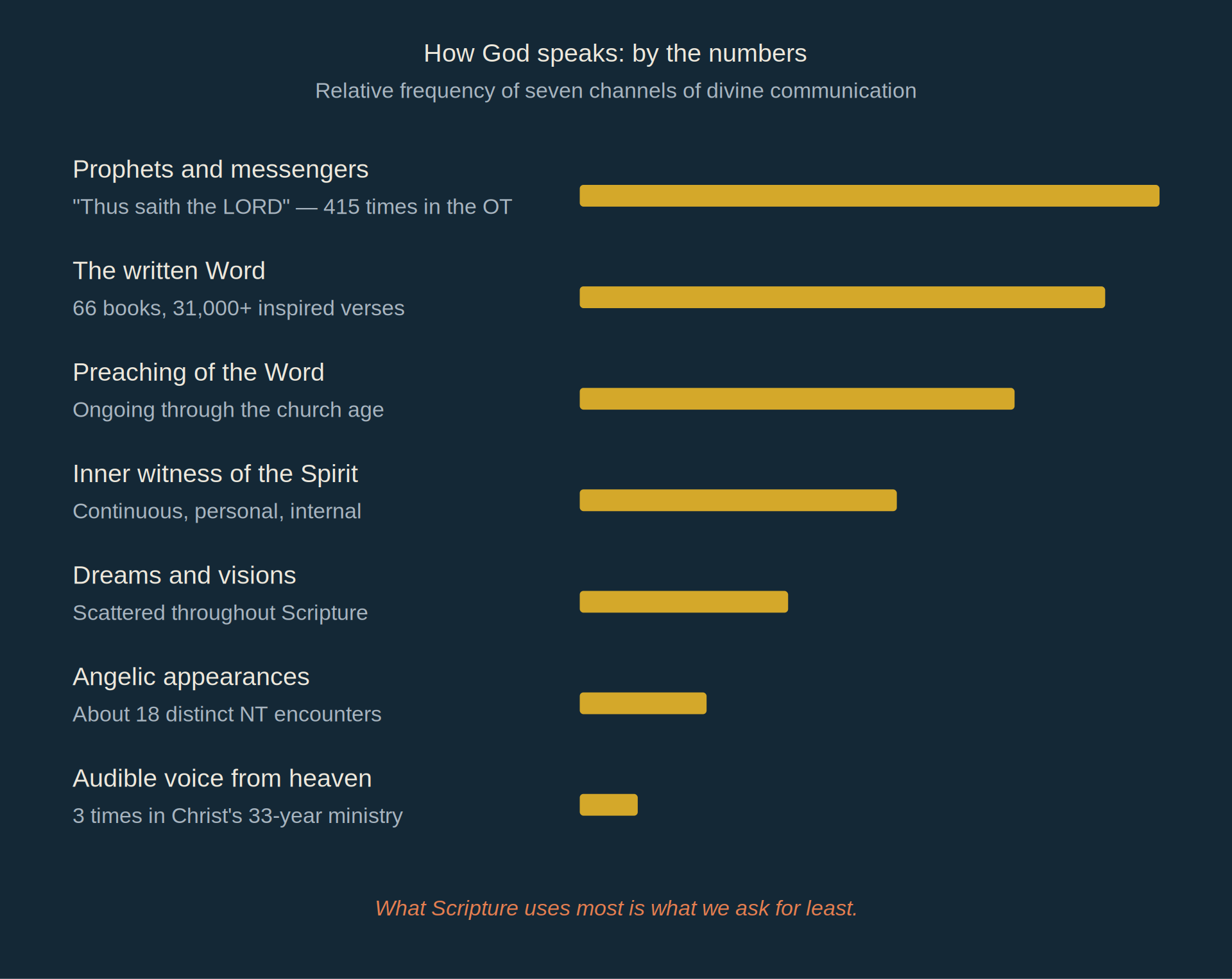
The phrase “thus saith the LORD” appears more than four hundred times in the King James Bible. Every one of those is a prophet — a man — delivering God’s message to others. Every major book of the Old Testament after the Pentateuch is either a record of prophetic mediation or a history of how God’s people responded to it. Even angels in Scripture are messengers by definition — the Greek word angelos and the Hebrew word malak both literally mean “messenger.”
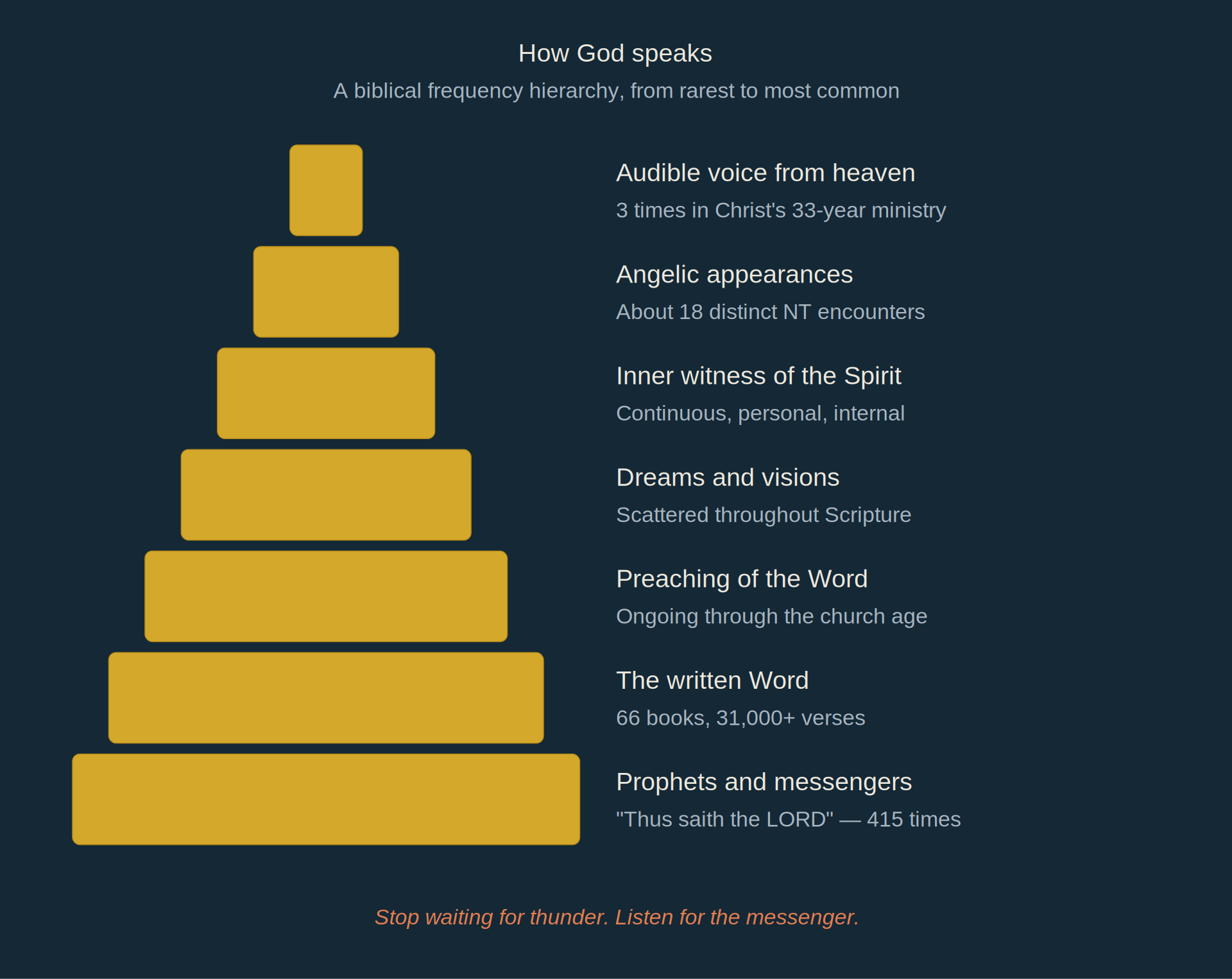
The pattern is overwhelming. Direct, dramatic encounters with God are rare and unforgettable precisely because they are rare. The normal way God speaks is through someone He has sent.
And yet many believers want to bypass the messenger entirely. They want the private vision, the personal whisper, the unmediated word — anything to avoid sitting under a pastor, receiving correction from a leader, or honoring the office of a man God has set in place. That is not faith. It is pride dressed up in spiritual language.
Christians who jump from church to church, sample sermons online, and never sit consistently under faithful preaching cannot expect to hear God speak through a means they refuse to engage. Plant yourself in a local church. Sit under preaching. Receive the warnings of those God has placed over your life. The voice you’ve been waiting for may already be in the room. It may be coming through the very pulpit you’ve been tempted to walk away from.
6. We Can’t Recognize His Voice Because We’ve Become Goats Instead of Sheep
This is the most uncomfortable point in the article, and it is the most important.
Jesus said, “My sheep hear my voice, and I know them, and they follow me” (John 10:27). And again: “He that is of God heareth God’s words: ye therefore hear them not, because ye are not of God” (John 8:47).
Read those statements carefully. Inability to hear God is not always a technical problem of distraction or busyness. Sometimes — often — it is a relational problem. It is not that God has gone silent. It is that you are no longer His.
Sheep recognize the shepherd’s voice. They have lived under his care. They have followed his pattern. They know the cadence of his calling. Goats don’t.
Many who fill pews on Sunday are goats wearing sheep’s clothing. They have a form of godliness but deny the power. They come to church but live like the world. They claim Christ but follow the flesh. And then they wonder why God seems silent — they’ve abandoned the relationship that makes hearing possible.
The remedy is not a louder God. The remedy is repentance.
Come back. Surrender. Submit. The Shepherd hasn’t moved — His sheep have wandered. Stop wandering. Stop pretending. Stop playing games with sin while expecting intimacy with the Savior. Return to Him with a whole heart, and you will hear Him again — not because God started talking, but because you finally became the kind of soul that can.
He’s Speaking. Are You Listening?
God is not silent. He never has been.
He spoke worlds into existence. He spoke prophets into nations. He spoke His Son into a virgin’s womb. He spoke His Spirit onto a hundred and twenty in an upper room. He has not stopped.
The question is whether you are positioned to hear.
Get quiet. Get still. Open the Book. Submit to the preached Word. Walk toward the fire. Pull the plug on the noise. Repent of whatever has dulled your ears.
Then listen.
He’s whispering. And what He has to say is worth everything.


